AI and OpenAPI Training for Enterprise IT
Česká spořitelna
Strategy & Training, AI & Automation
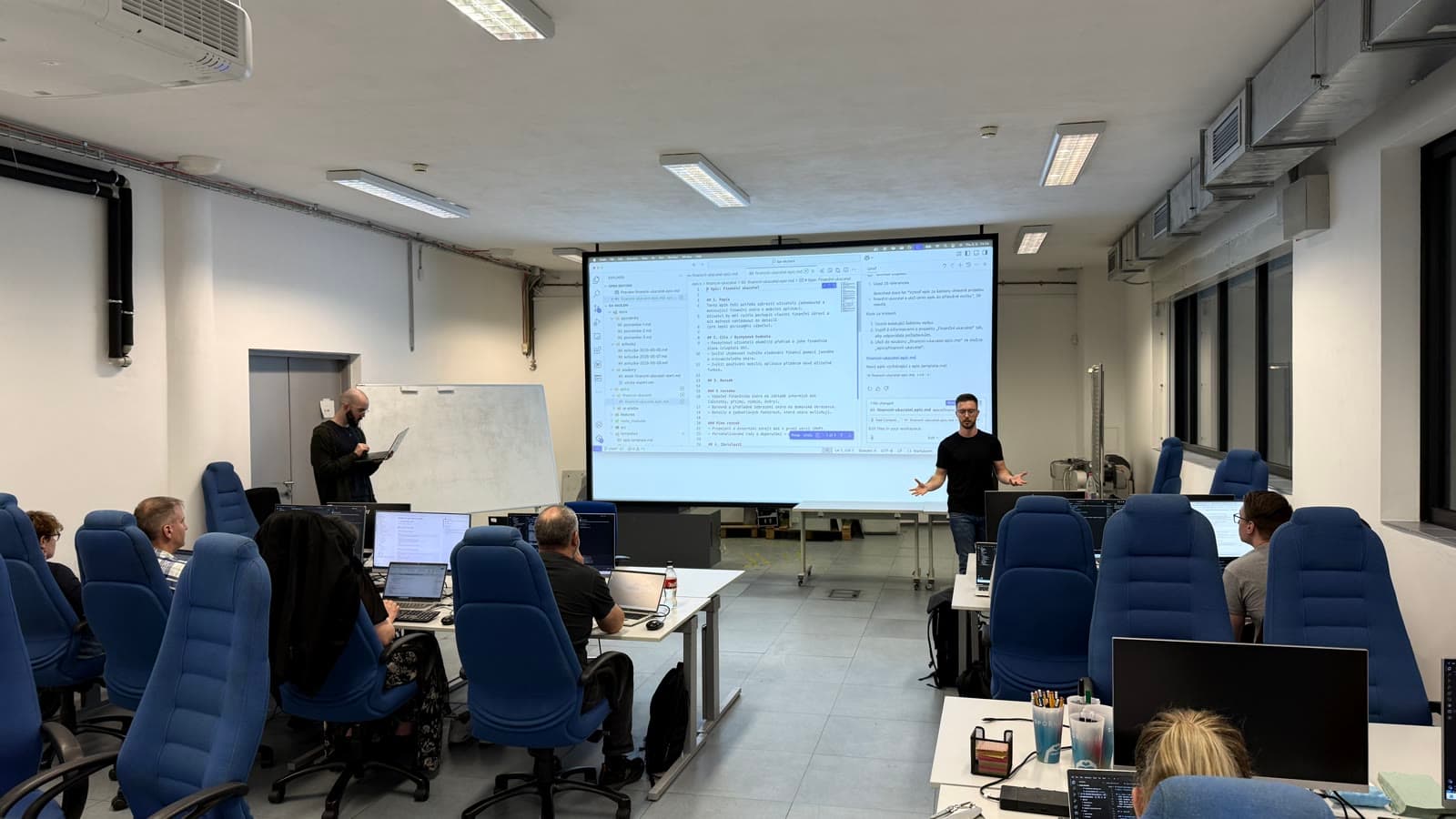
270+ people trained across IT roles
26 AI and OAS training runs
3 role-specific tracks
Detail
6 billion
tokens processed across our AI tools in 30 days
100
AI-eNPS of our team, measured by AI Pulse
76 %
response rate of AI Pulse micro-surveys
Teams want AI tools. Security wants control. Finance wants to know whether the investment pays off. Without a shared platform, each of those pulls in a different direction, and adoption stops at the pilot stage.
Security
People connect AI tools to company data on their own. Nobody can list which tools touch which systems, and the first complete inventory usually happens during an incident.
Operations
Every AI client needs every tool configured again: Cursor, Claude, VS Code, each with its own config file. Setup multiplies, and no two people work with the same tool set.
Security
API keys and OAuth secrets live in plain-text config files on laptops. Offboarding means hoping you found every copy.
Finance
You pay for licences and tokens, but nobody can say who actually uses AI, where it helps, and whether the investment pays off. Decisions run on anecdotes.
Compliance
Regulatory obligations are phasing in through August 2026 and beyond. Regulators and auditors will ask for evidence of how AI is used in your company, and IDE logs will not be the answer.
The platform sits between your people's AI tools and your systems. The DX MCP Gateway governs the traffic, the AI Telemetry Hub measures it, AI Pulse asks people whether it actually helps, and AuthLane hands out credentials so nobody else has to. Each component works on its own; together they close the loop from governance to evidence. The control plane has two doors: the DX MCP Gateway for tool calls and the AI Gateway for model calls.
AI clients
Tools & MCP servers
AI models
The numbers at the top of this page come from our own internal deployment, collected and rendered by the platform itself.
“I see up close how DX Heroes run the platform on themselves. Six billion tokens a month is not a marketing number, it's real production traffic — and that is exactly the measurement most companies are missing when they decide about AI.”
Vratislav Kalenda — Founder, Applifting
Beyond our own use, the gateway runs in production in regulated environments: two enterprises in the Czech Republic and a bank in Slovakia.








Control plane
Every AI tool call goes through one governed door.
Roll AI tools out to the whole company without losing track of what they touch. The gateway aggregates your MCP servers behind curated profiles, so every AI client gets exactly the tools its workflow needs. Security gets structured traces and audit-ready answers instead of scattered IDE logs.
Profiles per team: coding, research, support, or your own
Every tool call recorded, exportable over OpenTelemetry and to your SIEM
OAuth 2.1 with PKCE and Dynamic Client Registration, human approval for risky tools
Self-hosted: Docker Compose, Kubernetes, or OpenShift Helm chart
AI Gateway
The control plane's second door: a proxy for LLM calls compatible with the OpenAI and Anthropic APIs. Model traffic gets the same governance, audit trail, and telemetry as tool calls, and provider keys stay out of laptops.
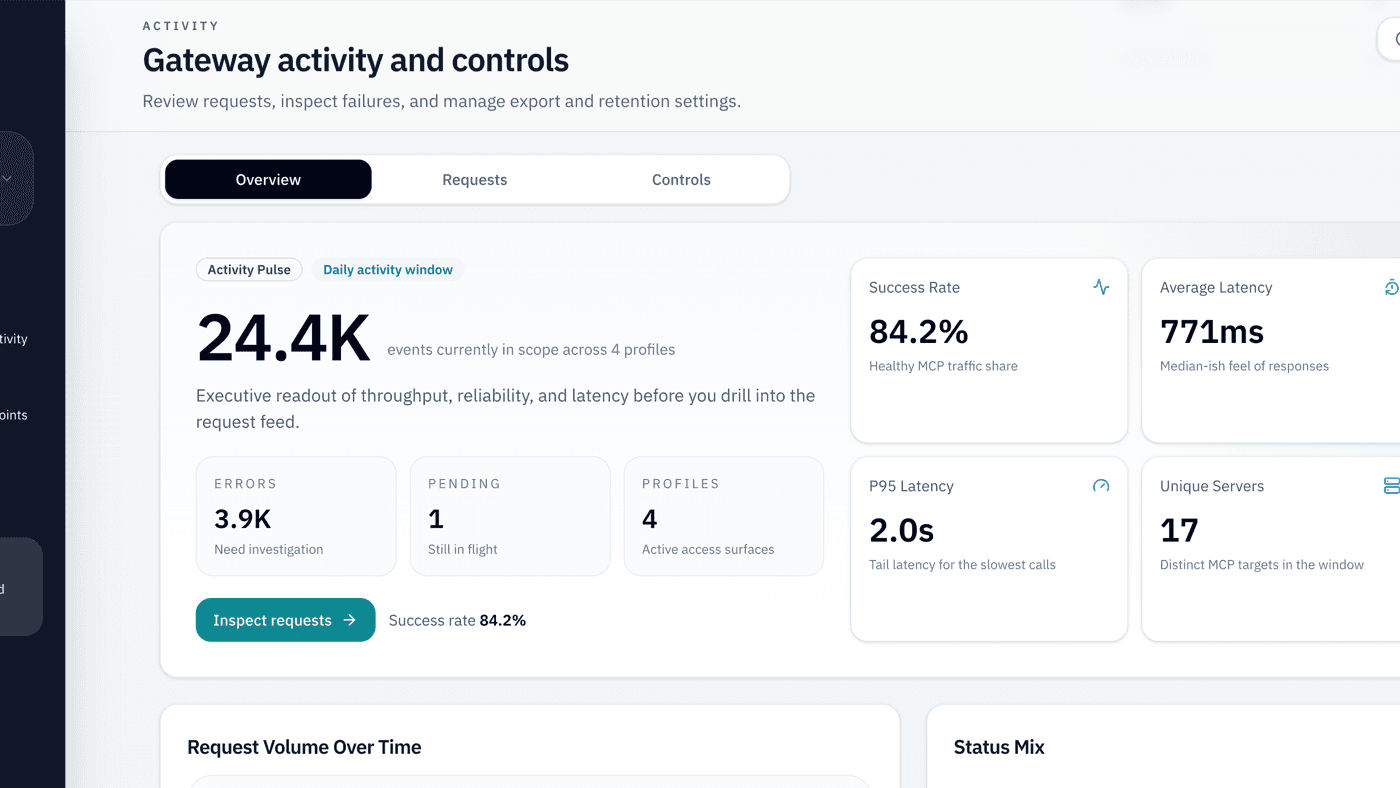
One readout of MCP traffic health for platform and security teams.
Insight plane
One dashboard for what AI costs and whether it pays off.
Decide about licences and rollout from data instead of anecdotes. The AI Telemetry Hub collects OpenTelemetry from Claude Code, Claude Cowork, Cursor, GitHub, and the gateway into one time-series store and renders dashboards for utilization, cost, ROI, and delivery guardrails. It is open source under the MIT licence and runs next to the gateway on your infrastructure.
Collects from the tools your teams already use, no agents on laptops
Dashboards from executive KPIs down to a per-developer enablement view
Adoption funnel: who has access, who uses AI, who is a power user
Open source (MIT), with 5-year metric retention in your perimeter
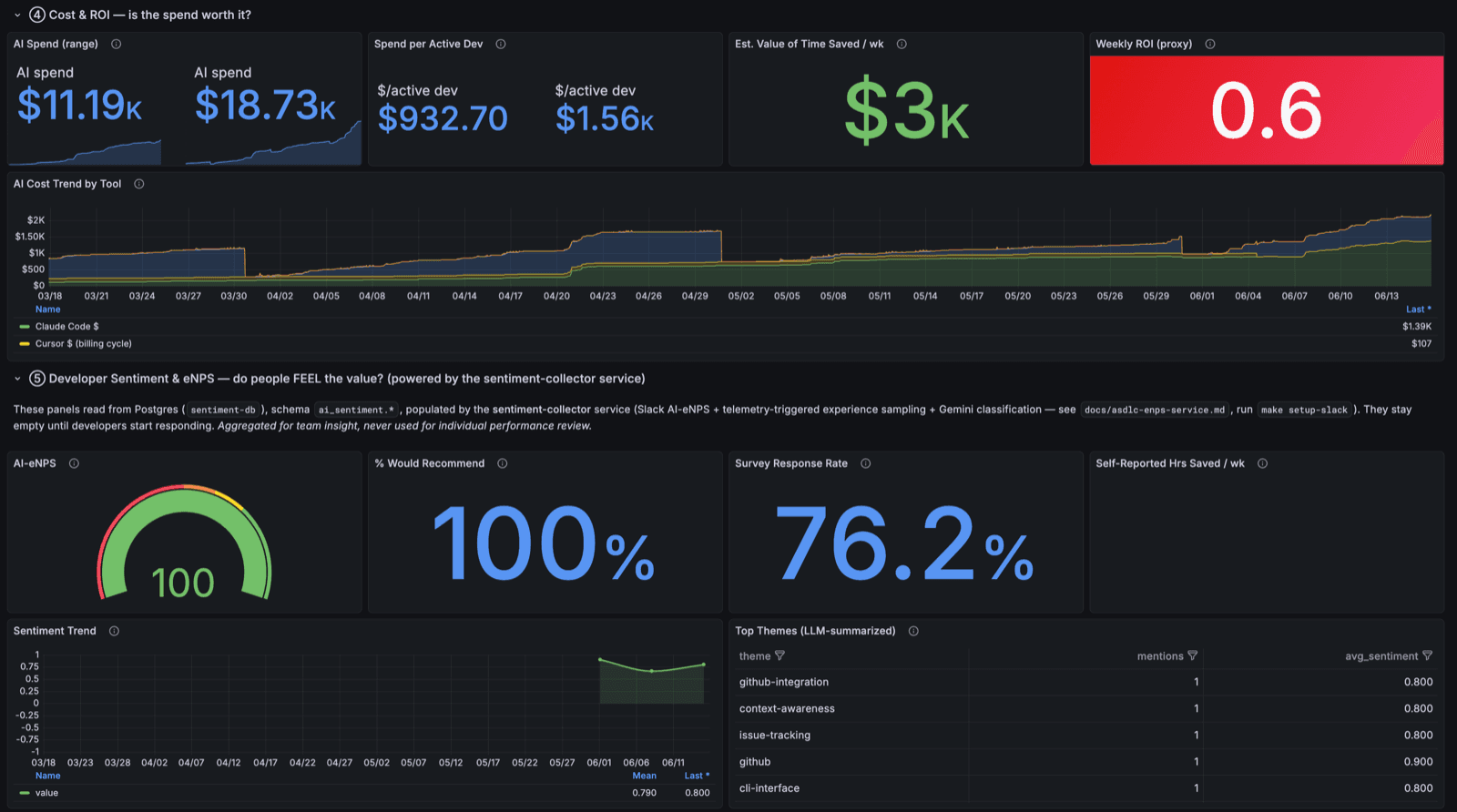
Cost and ROI next to sentiment: our own internal data, measured by the platform itself.
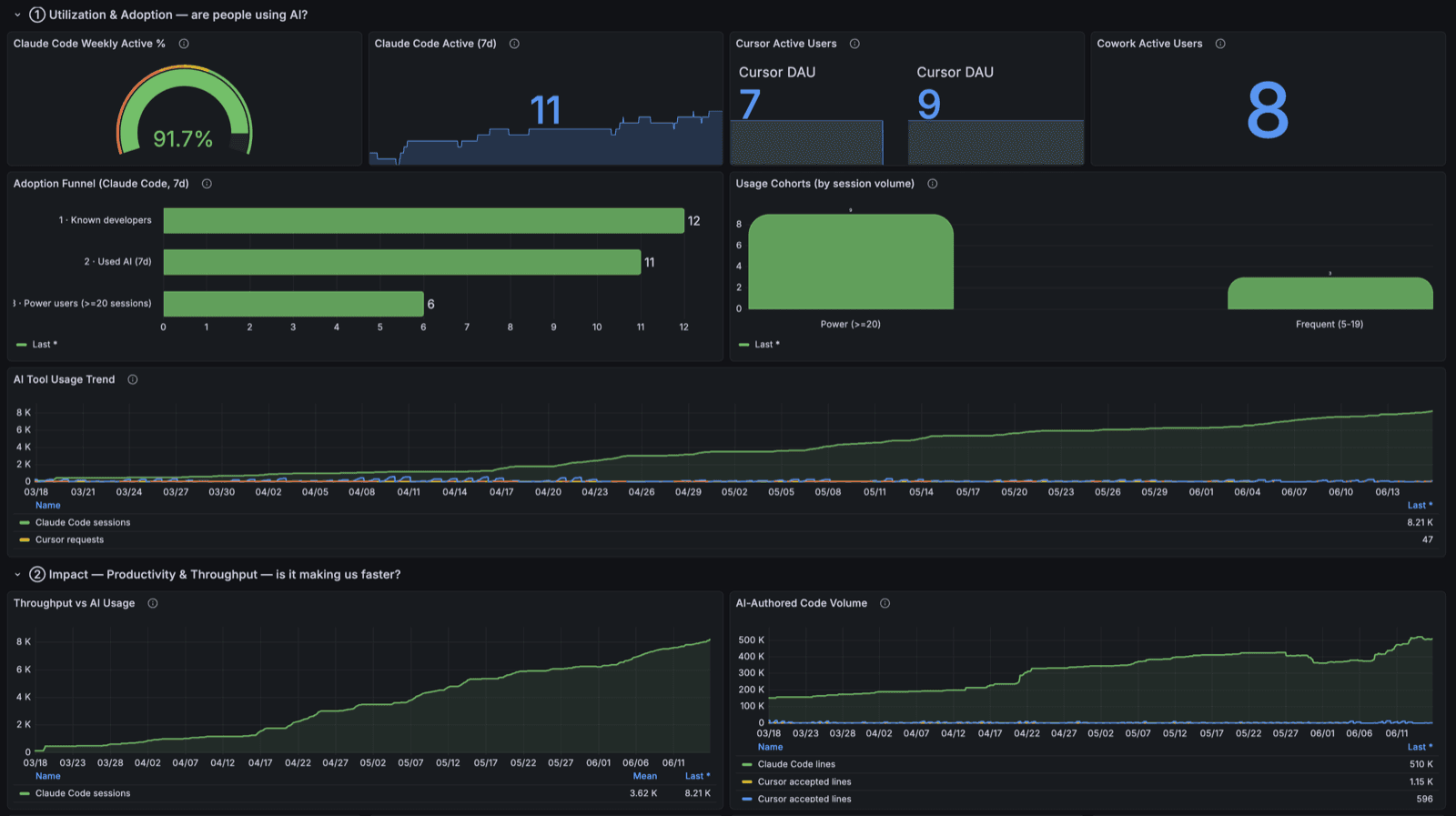
Adoption funnel from known developers to power users.
Employee sentiment
Numbers show usage. AI Pulse shows whether it helps.
Telemetry tells you tokens were burned, not that value was delivered. AI Pulse asks people across the company directly: short questions in Slack, targeted by what each person actually used, so nobody answers surveys about tools they never touched. An LLM summarizes the answers into themes and an eNPS trend, and the results land next to the hard telemetry in one perception-versus-reality view.
Weekly one-question pulses and a quarterly snapshot built on DORA and DX research wording
Experience sampling triggered by real activity, rate-limited so it never spams
eNPS, themes, and self-reported hours saved, summarized by an LLM
Aggregated for team insight, never used for individual performance review
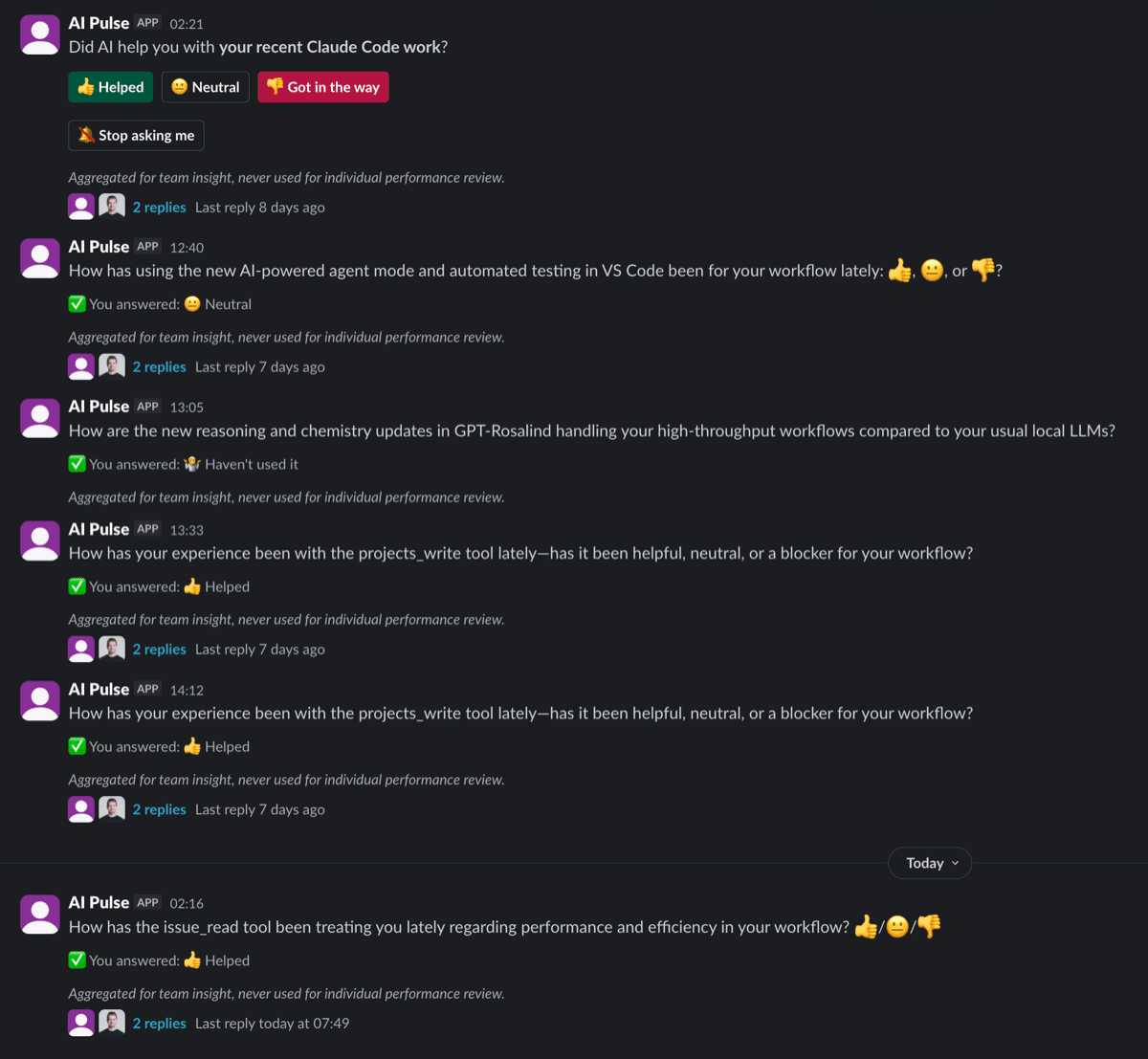
A short question in Slack, answered with one click. That is the entire survey.
Auth plane
Agents get scoped access. People stop handling secrets.
Connecting an AI agent to company services should not mean pasting client IDs and secrets into config files. AuthLane keeps OAuth credentials in one encrypted vault, lets people connect approved services with a click, and hands agents scoped tokens plus ready-made tool definitions. When someone leaves, you revoke their access in one place.
Credential vault encrypted with AES-256-GCM, automatic token refresh
Per-user connections: each person authorizes only their own accounts
Tool definitions exported in MCP and OpenAI function formats
GitHub, Slack, Jira, Notion, and more today; enterprise integrations such as Microsoft Entra or SharePoint we prepare as part of the rollout
AI clients pass through the gateway, and every request is recorded. Usage data flows into one overview, and AI Pulse adds people's feedback next to it. None of it leaves your company.
The platform runs on your own servers or in your cloud, from a pilot to a company-wide rollout. Configuration, records, and survey answers stay in databases you operate. There is no vendor-hosted control plane.
Secrets and access are encrypted and never sit on laptops. People sign in with your corporate SSO, and audit records feed into your security monitoring (SIEM). Your security team has everything evidenced in one place.
A regulated EU company weighing AI infrastructure usually shortlists four kinds of alternatives. Here is where each one is strong, and where you hit its limits.
Runs in your perimeter
Governance across clients & servers
AI adoption measurement
Agent auth & credentials
Pricing model
DX Heroes AI Platform
Govern, measure, and authorize in one platform
EU company, and everything including the control plane runs in your perimeter
One control plane across all your AI clients and MCP servers
Native: usage, cost, ROI, and employee sentiment on real traffic
OAuth 2.1 with PKCE and DCR at the gateway, plus the AuthLane credential vault
Flat annual licence, no per-seat or per-call metering
Hyperscaler agent gateways
e.g. AWS AgentCore, Azure APIM, Google Apigee
EU regions available, but the control plane stays in the vendor's cloud
Strong API governance, MCP support bound to their own stack
Infrastructure telemetry only, no adoption, ROI, or sentiment view
Own identity services, tied to their cloud
Metered per call and per token
US SaaS platforms
e.g. Composio, Arcade, MintMCP
Managed SaaS by default; self-host typically reserved for enterprise tiers, entity under US jurisdiction
Mature gateways and large tool catalogs
Audit logs and security observability, not adoption or sentiment
Strong tool-auth products
Per tool call with overages; published prices change often
EU sovereign platforms
e.g. Frends, STOA
Yes, EU entities with on-prem options
Solid, anchored to each platform's own runtime and scope
Process audit and cost observability, no adoption or sentiment measurement
Inbound auth policies; delegated credential brokering is not the focus
Custom enterprise pricing
DIY from open source
e.g. ContextForge or Obot plus your own OTel stack
Fully in your perimeter
You build and maintain it as the MCP spec keeps evolving
Infra metrics out of the box; adoption measurement becomes your own project
Available in pieces, integration is on you
Free licences, paid in engineering time
DX Heroes AI Platform
Govern, measure, and authorize in one platform
Runs in your perimeter
EU company, and everything including the control plane runs in your perimeter
Governance across clients & servers
One control plane across all your AI clients and MCP servers
AI adoption measurement
Native: usage, cost, ROI, and employee sentiment on real traffic
Agent auth & credentials
OAuth 2.1 with PKCE and DCR at the gateway, plus the AuthLane credential vault
Pricing model
Flat annual licence, no per-seat or per-call metering
Hyperscaler agent gateways
e.g. AWS AgentCore, Azure APIM, Google Apigee
Runs in your perimeter
EU regions available, but the control plane stays in the vendor's cloud
Governance across clients & servers
Strong API governance, MCP support bound to their own stack
AI adoption measurement
Infrastructure telemetry only, no adoption, ROI, or sentiment view
Agent auth & credentials
Own identity services, tied to their cloud
Pricing model
Metered per call and per token
US SaaS platforms
e.g. Composio, Arcade, MintMCP
Runs in your perimeter
Managed SaaS by default; self-host typically reserved for enterprise tiers, entity under US jurisdiction
Governance across clients & servers
Mature gateways and large tool catalogs
AI adoption measurement
Audit logs and security observability, not adoption or sentiment
Agent auth & credentials
Strong tool-auth products
Pricing model
Per tool call with overages; published prices change often
EU sovereign platforms
e.g. Frends, STOA
Runs in your perimeter
Yes, EU entities with on-prem options
Governance across clients & servers
Solid, anchored to each platform's own runtime and scope
AI adoption measurement
Process audit and cost observability, no adoption or sentiment measurement
Agent auth & credentials
Inbound auth policies; delegated credential brokering is not the focus
Pricing model
Custom enterprise pricing
DIY from open source
e.g. ContextForge or Obot plus your own OTel stack
Runs in your perimeter
Fully in your perimeter
Governance across clients & servers
You build and maintain it as the MCP spec keeps evolving
AI adoption measurement
Infra metrics out of the box; adoption measurement becomes your own project
Agent auth & credentials
Available in pieces, integration is on you
Pricing model
Free licences, paid in engineering time
If your company is all-in on a single cloud and your data may live there, the hyperscaler gateway is a reasonable default. If you need one governed control plane across clouds, IDEs, and internal tools, running inside your own perimeter, that is what the DX MCP Gateway is built for.
If you only need Copilot numbers, GitHub's built-in dashboards are enough. For engineering benchmarking, measurement-only tools such as Faros AI or DX do a good job. If you want measurement wired into the same layer that governs the traffic, including how people feel about it, that is the Telemetry Hub with AI Pulse.
If you are building a SaaS product that needs tool auth for your customers, developer platforms serve that well. If you are rolling out agents inside a company and refuse to hand out secrets, AuthLane with the gateway keeps credentials in one governed place.
Snapshot of public vendor documentation, July 2026. This market moves fast; we keep the table current.
The comparison is category-level and based on public vendor documentation as of July 2026. Verify the details against your requirements; we are happy to help with the mapping.

“Our collaboration with DX Heroes was a no-brainer in taking the development team to the next level. Each and every day, we need to improve, and the experience DX Heroes gained from both their internal and on-demand development is a guarantee of best practices, validated time and again. Our team definitely feels the added value of good developer experience; DX Heroes truly have a knack for measuring it and pushing things to the next level.”
25% time saved

“Our collaboration brought excellent results. It led to the release of a completely redesigned API and a new developer portal. The extended partnership then created a solid foundation for our further cooperation in the area of developer experience.”
4 SDKs developed

“We've been working with the DXH team over 3 years on a wide range of projects involving technical analysis, developer documentation and integration developments. Their performance has been nothing short of outstanding. They've approached the projects with a sense of responsibility, solid expertise, and resourcefulness. There were many moments where the collaboration with DXH made the difference between success and failure in making our technology work for our customers – nothing short of heroic.”
4 years of cooperation

“Partnerships are a core value for MassPay. We don't use this word lightly, and we don't enter into it without purpose. Partnering with DX Heroes to support our burgeoning developer ecosystem and community has dramatically benefited MassPay and our customers. The partnership has been a success, from rapid project alignment to real-time collaboration.”
32% faster integration

“It is always difficult to coordinate integration testing and debugging, and we needed to deal with six teams of participating banks at the same time. Thanks to the DX Heroes people everything went smoothly and we were able to solve all integration issues in the different systems of the involved banks. DX Heroes demonstrated not only perfect work organization and extraordinary work commitment, but also a proactive approach in the many crisis situations we dealt with. I especially appreciate the ability to come to a consensus across different solution teams and bring everything to a successful completion.”
1.6M users in the first year

“We were looking for external input on how to design a developer portal well. DX Heroes helped us improve the overall onboarding experience from start to finish with focus on product usability.”
47% faster integration

“Together with DX Heroes, we have focused on improving the developer experience of our payment methods, making developers work on average a third less time than before. This has a huge impact on the experience of our service and tremendously helps our core business.”
7 new technical guides created
“Our collaboration with DX Heroes was a no-brainer in taking the development team to the next level. Each and every day, we need to improve, and the experience DX Heroes gained from both their internal and on-demand development is a guarantee of best practices, validated time and again. Our team definitely feels the added value of good developer experience; DX Heroes truly have a knack for measuring it and pushing things to the next level.”
25% time saved
“Our collaboration brought excellent results. It led to the release of a completely redesigned API and a new developer portal. The extended partnership then created a solid foundation for our further cooperation in the area of developer experience.”
4 SDKs developed
“We've been working with the DXH team over 3 years on a wide range of projects involving technical analysis, developer documentation and integration developments. Their performance has been nothing short of outstanding. They've approached the projects with a sense of responsibility, solid expertise, and resourcefulness. There were many moments where the collaboration with DXH made the difference between success and failure in making our technology work for our customers – nothing short of heroic.”
4 years of cooperation
“Partnerships are a core value for MassPay. We don't use this word lightly, and we don't enter into it without purpose. Partnering with DX Heroes to support our burgeoning developer ecosystem and community has dramatically benefited MassPay and our customers. The partnership has been a success, from rapid project alignment to real-time collaboration.”
32% faster integration
Interested in the DX Heroes AI Platform?
Tell us about your environment and we'll prepare a demo and a rollout proposal tailored to your organization.

Prokop Simek
CEO
With over 12 years in software engineering, I lead our strategy and sales and advise enterprise teams on AI adoption. My job is to connect business with technology so it actually pays off.
In your deployment. Gateway configuration, traces, credentials, telemetry, and survey answers stay in databases on infrastructure you operate. None of the components depends on a vendor-hosted control plane, and nothing phones home.
It gives you the evidence layer: an inventory of AI tools in use, an audit trail of every tool call, and usage reporting per team and per system. That covers the documentation and oversight questions auditors ask first. It is not a legal compliance service, and we are clear about that; your counsel maps the obligations, the platform produces the evidence.
The platform is designed for enablement, not surveillance. AI Pulse answers are aggregated for team insight and every survey states that they are never used for individual performance review. Per-developer telemetry views exist for coaching and onboarding, and access to them is under your control, including retention.
Today AuthLane ships integrations including GitHub, Slack, Jira, Notion, Google Workspace, Salesforce, and HubSpot, and exports tool definitions in both MCP and OpenAI function formats. Enterprise systems such as Microsoft Entra or SharePoint are prepared as part of the rollout, which is typically how we deploy the platform in regulated environments.
Yes. Alongside the MCP door for tool calls, the control plane includes the AI Gateway: a proxy for LLM calls compatible with the OpenAI and Anthropic APIs. Model traffic gets the same governance, audit trail, and telemetry as tool calls, and provider keys stay in the gateway instead of laptops and config files.
No. Most companies start with the gateway for governance or with the Telemetry Hub for measurement. The components share one telemetry pipeline, so each later addition plugs into what you already run instead of starting over.
Talk to us for a walkthrough, then we typically run a focused proof of concept on your infrastructure so platform and security teams can validate it in their own environment. Licensing is a flat annual fee; deployment, hardening, and integration with your identity stack are part of the engagement.
Česká spořitelna
Strategy & Training, AI & Automation
270+ people trained across IT roles
26 AI and OAS training runs
3 role-specific tracks
Detail
Dateio
AI & Automation, Custom Development
10-min setup
47% faster integration
73M users
Detail