
Developer marketing doesn't exist... without DevX
Length:
8 min
Published:
December 11, 2024

Yes, the title plays on Adam DuVander's book. But before you write this off as another take on developer marketing, let's be clear. In an earlier post we pushed back on the cliché that developers hate marketing. Our point was that developers appreciate marketing that doesn't feel like marketing. If you can spare the time, that article is worth a read.
Here is the catch. Even a brilliant developer marketing strategy falls apart without a solid developer experience (DevX) underneath it.
Developers are sharp, skeptical, and drowning in options. Flashy features and hype don't impress them, at least not enough to keep them around. They care about authenticity, efficiency, and tools that fit their workflow. So what's the point of pouring money into marketing if your DevX is poor?
This article is meant to push your thinking and your actions on developer experience. We'll show how neglecting DevX undercuts your marketing and pushes away the very people you want to reach.
Why developer experience is the backbone of developer marketing
I love how Jennifer Riggins describes developer experience, especially the last line:
Developer experience is an extension of UX that focuses on the developer, who can either be the intermediary or, as is the case with many APIs, the end user. Whether or not you focus on DX design, your developers are always experiencing your API, and that experience may either be positive or negative.
Could not agree more.
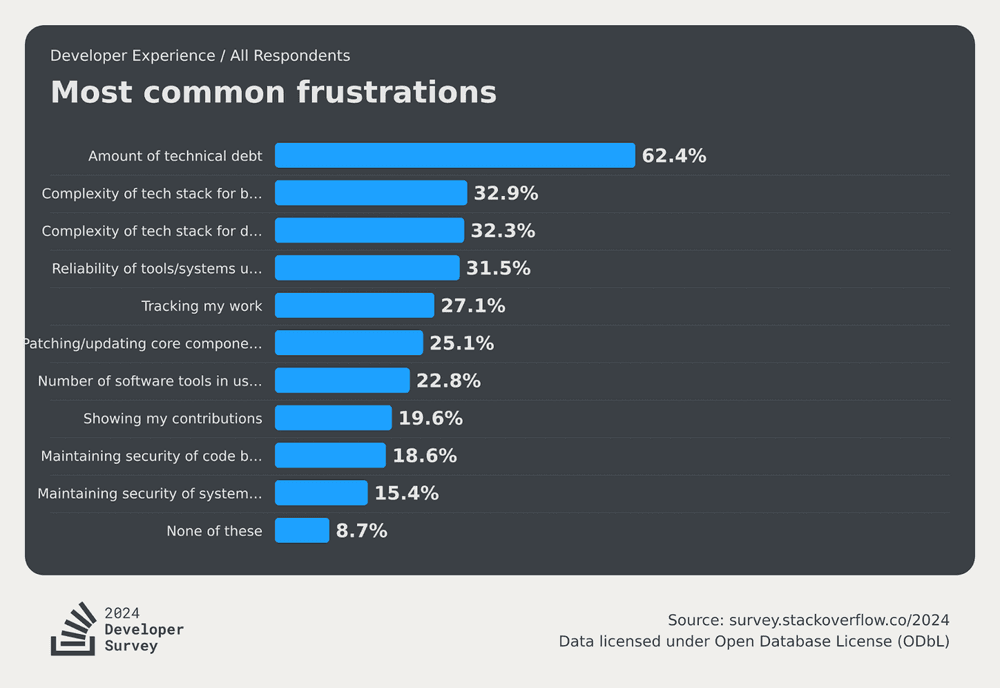
Heading into 2025, you'd think DevX would finally get a break, with AI taking over everything. Nope. The 2024 Stack Overflow Developer Survey shows technical debt is the biggest developer frustration (62.4%), with complex tech stacks right behind it. DevX is still a mess, and honestly, a fix isn't coming any time soon. So we'll keep poking until someone listens.
Developers get hit with ads and pitches every day, and they've grown a sharp filter for the noise. Your marketing has to match the experience your product actually delivers, or it won't connect.
Promise simplicity and efficiency, then ship something clunky, and you're in trouble. Developers stop trusting you, and trust is everything. They lean on peers and communities for advice, so one bad experience spreads fast through forums, social media, and professional networks, and it undoes all your marketing work.
When DevX fails, so does everything else
When DevX fails, the ripples are impossible to miss. Bad reviews spread like wildfire, and no amount of marketing fixes the damage. For developers, the experience is not one feature, it's the whole product. Here is exactly how a failing DevX derails the rest of your marketing.
Overwhelming developers too early
As Adam DuVander put it, the first impression is everything, especially in developer experience. You wouldn't sign up for a service only to be handed a 50-page manual before you start. Cristiano Betta calls this "performance overload". Developers have no time for complicated instructions. They want a simple, smooth onboarding that gets them running fast.

So how do you keep it simple?
- Simplify onboarding: focus on the steps people actually need to get started.
- Use progressive disclosure: introduce advanced features as the developer gets comfortable.
GitHub does this well by letting people sign up with minimal information. It introduces heavier features like repositories, organizations, and integrations only as you explore. That respects a developer's time and keeps the cognitive load low. But onboarding is only the start. What happens when your documentation falls behind?
Poor documentation leaves developers lost
If onboarding is the first hurdle, documentation is the marathon. It's the backbone of any good development process. Poor or incomplete docs leave developers lost and frustrated. The logic is simple: when developers can't find what they need, they waste time, make mistakes, and lose confidence in your product.

How do you fix it?
- Make navigation obvious: use headings, subheadings, and a logical hierarchy.
- Include code examples: practical snippets help developers understand the implementation fast.
Facebook's developer documentation is a good example. It's structured, easy to navigate, and full of practical examples that walk developers through even complex integrations. Even great docs won't help, though, if your product ignores the platform standards developers rely on.
Ignoring platform standards breeds distrust
Developers are creatures of habit. They rely on established workflows and norms to stay efficient. When your product ignores platform standards, it creates friction and erodes trust. It's like driving on the wrong side of the road.
To build trust:
- Respect platform idioms: stick to the conventions and patterns familiar on that platform.
- Ensure compatibility: test across environments and versions.
For example, API documentation for Python developers that follows the PEP 8 style guide signals respect for the community and lowers the barrier to adoption. But even flawless standards need solid tools behind them.
A lack of good tools pushes developers away
Even the best docs and platform alignment won't save you if your tools fall short. Developers rely on SDKs, libraries, and plugins to move faster. If those are buggy, outdated, or missing, they go elsewhere.
How to ship tools developers can trust:
- Offer official SDKs: cover the languages your audience actually uses.
- Maintain them: fix bugs fast and keep up with the latest platform updates.
PayPal learned the hard way what happens when you neglect SDKs. A pile of unofficial, inconsistent libraries appeared, and it confused and frustrated developers. Stripe took the smarter route with reliable, well-maintained SDKs across multiple languages. Developers trust Stripe because they know the tools will hold up.
Neglect any part of DevX, onboarding, documentation, platform standards, or tools, and you don't only fail developers. You fail your marketing, your product, and in the end your business.
A great developer experience boosts advocacy on its own
A good developer experience turns developers into enthusiastic advocates. When the experience is smooth and enjoyable, they want to share it. They become champions for your product, recommend it to peers (a survey by Evans Data Corporation found that 92% of developers are influenced by peer recommendations), write tutorials, and build it into their projects.
When Twilio launched in 2008, it bet heavily on DevX with excellent documentation and easy-to-use APIs. Developers loved it and spread the word, which carried Twilio to the front of communication APIs.
Continuous improvement also builds lasting trust. Developers notice when you listen to feedback and act on it. Regular updates, fast bug fixes, and new features show you take their needs seriously.
Questions to help you reach a great DevX
Our friends at DX Heroes, led by their CEO Prokop Simek, know a thing or two about building strong developer experiences. Prokop shared a set of practical questions you can use to evaluate and improve your DevX, from clarity to ease of use:
- Does the product show its benefits to developers? Back it with examples.
- How fast can a developer try it or see it in action? Put demos and examples front and center.
- Is adoption fast and simple? Cut the steps it takes to start.
- Is generating an API key quick and intuitive? Developers hate waiting for access.
- Are the getting-started instructions easy to follow? Clarity here makes or breaks the first impression.
- Is registration required to try it? If so, make it as painless as possible.
- Are the configuration options clear and well documented? Ambiguity leads to frustration.
- Is the API well documented, with examples and SDKs? Developers value tools that work out of the box.
- Is API versioning handled well, with changes communicated clearly? Surprises are never welcome.
- How fast can the product be integrated? Speed matters, especially for APIs and SaaS tools.
- Is responsive support available when something breaks? Fast help during a roadblock is a dealbreaker.
I recommend their article on external developer experience for more on this topic.
Wrapping up
Developer marketing should amplify your product's strengths, not paper over its weaknesses. If the core experience is weak, marketing only broadcasts those weaknesses to a bigger audience.
You can run the most creative campaigns with the biggest budgets, but without solid DevX, it's wasted. Developers are partners in building, not just consumers. Treat them that way.
To raise your DevX, consider working with experts like DX Heroes. They help by building developer portals and other products that improve workflow, efficiency, and productivity for startups and enterprises.
When you're ready to communicate your product's value, our SaaS content agency delivers technical content that guides the developer journey, speeds up adoption, and supports a strong go-to-market.
Want to stay one step ahead?
Don't miss our best insights. No spam, just practical analyses, invitations to exclusive events, and podcast summaries delivered straight to your inbox.